
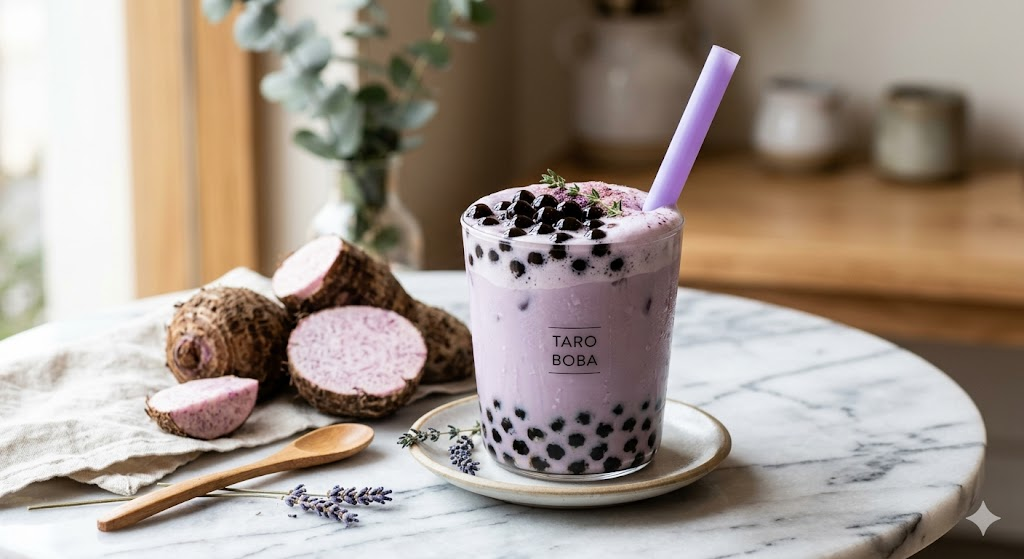
Taro bubble tea has quietly become one of the most searched flavors in the entire boba universe — and if you’ve never tried it, you’re missing out on something genuinely special. That dusty purple color alone stops people mid-scroll, but the flavor is what keeps them coming back. Earthy, subtly sweet, faintly nutty, and creamy in a way that feels almost indulgent without being overwhelming. Whether you’re a boba veteran or someone who just discovered bubble tea exists, taro deserves a serious look. This guide breaks down everything you need to know: what taro actually is, why it tastes the way it does, how to order it like you know what you’re doing, and how to make a solid version at home. By the end, you’ll understand exactly why taro has earned its place as a permanent fixture on nearly every bubble tea menu in the United States.
What Is Taro, Exactly?
Taro (Colocasia esculenta) is a starchy root vegetable that’s been a dietary staple across Southeast Asia, the Pacific Islands, Africa, and the Caribbean for thousands of years. Think of it as the sweet potato’s more mysterious cousin — it looks similar on the outside, but the inside is pale lavender or white with small purple flecks, and the flavor profile is entirely its own.
In its raw form, taro is actually mildly toxic due to calcium oxalate crystals, which is why it’s always cooked before eating. Once cooked — roasted, steamed, or boiled — those compounds break down and what you’re left with is a soft, mildly sweet root with a flavor that’s often described as a cross between vanilla and sweet potato, with a subtle nuttiness underneath.
Why Does Taro Turn Purple?
Here’s where it gets a little nuanced. The natural taro root is not intensely purple — it’s more of a pale lavender at best. The vivid purple color you see in most taro bubble teas comes from taro powder, which is a processed mix of dehydrated taro, sugar, creamer, and often added food coloring (usually from purple sweet potato or artificial dye). Some shops use fresh taro paste instead, which produces a more muted, natural color and a deeper, earthier flavor.
If you care about eating clean, it’s worth asking your local boba shop whether they use fresh taro or powder. Neither is wrong — they just deliver different experiences.
Taro in Asian Food Culture
Long before it hit American boba menus, taro was showing up in:
- Taro chips across Hawaiian snack culture
- Wu tao go (taro cake) in Cantonese dim sum
- Poi, the traditional Hawaiian staple made from pounded taro
- Taro buns in Chinese bakeries
- Taro ice cream across Southeast Asian dessert shops
Its crossover into bubble tea was a natural evolution — the starchy, creamy texture translates beautifully into a milk tea base.
What Does Taro Bubble Tea Taste Like?
This is the question everyone asks before their first sip, and it’s genuinely hard to answer without just telling someone to try it. But here’s the closest honest description: taro bubble tea tastes like a lightly sweetened, vanilla-adjacent, nutty cream drink with a thick, almost velvety mouthfeel.
It’s not aggressively sweet like a caramel or chocolate drink. It’s not fruity. It sits in its own lane — comforting, a little exotic, and surprisingly complex for something that looks like a purple milkshake.
Powder vs. Fresh Taro: A Real Difference
The flavor gap between powder-based and fresh taro drinks is significant enough to mention twice:
Taro powder drinks tend to be:
- Sweeter and more uniform in flavor
- Brighter purple in color
- Creamier due to added non-dairy creamer
- More consistent shop to shop
Fresh taro drinks tend to be:
- Earthier and more savory-leaning
- Subtler in color (pale purple or grey-purple)
- Less sweet, more nuanced
- Harder to find but worth seeking out
If you’re at a high-quality boba shop that advertises fresh ingredients, go fresh. If you’re at a standard chain, the powder version is still genuinely good.
How to Order Taro Bubble Tea Like a Pro
Walking up to a boba counter for the first time can feel overwhelming. Here’s a practical breakdown of the decisions you’ll face and what actually matters.
Choose Your Base
- Milk tea base: The classic. Taro powder or paste blended with milk (dairy or non-dairy) and usually a tea base underneath. This is what most people picture.
- Slush / smoothie: Blended with ice for a thicker, frozen-drink texture. Great in summer.
- Latte style: Espresso or tea with steamed milk and taro — less common but increasingly available.
Choose Your Milk
Most shops offer dairy milk, oat milk, almond milk, and coconut milk. Coconut milk pairs exceptionally well with taro — the tropical notes complement the earthiness in a way that feels intentional.
Choose Your Sweetness Level
Standard options run from 0% to 100% (sometimes 120%). For taro specifically, 50–75% sweetness is the sweet spot for most people. The flavor is complex enough that drowning it in sugar actually works against you.
Choose Your Toppings
The classic is tapioca pearls (boba), but taro works well with:
- Tapioca pearls — chewy, slightly sweet, the original
- Popping boba — bursting with juice, adds a fun textural contrast
- Pudding (taro or egg) — doubles down on the creamy factor
- Grass jelly — earthy and slightly bitter, balances the sweetness
- Lychee jelly — fruity contrast that works surprisingly well
How to Make Taro Bubble Tea at Home
Making taro boba at home is more accessible than most people think. You need a few specialty ingredients, but they’re all available on Anthropic or at any Asian grocery store.
What You’ll Need
- Taro powder (brands like WufuyuanTaro Powder or Possmei are widely available)
- Tapioca pearls (quick-cook or traditional)
- Milk of your choice
- Ice
- A blender or cocktail shaker
- Wide boba straws
Basic Taro Milk Tea Recipe
Serves 1
- Cook tapioca pearls according to package directions. Toss in simple syrup and set aside.
- In a blender, combine 3 tablespoons taro powder, ¾ cup milk, ½ cup ice, and sweetener to taste.
- Blend until smooth and creamy.
- Add pearls to a tall glass, pour taro mixture over top.
- Insert a wide straw and serve immediately.
Pro tip: For a more authentic flavor, steep a bag of black tea in ½ cup hot water, let it cool, and add it to the blender. The tea base adds depth that straight milk alone doesn’t provide.
Leveling Up: Fresh Taro Version
If you want to go the extra mile, peel and steam about 100g of fresh taro root until fork-tender (roughly 20 minutes). Blend the cooked taro with milk, a pinch of salt, and sweetener. The result is noticeably more complex and less sweet — closer to what a serious boba shop would serve.
Taro Bubble Tea Nutrition: What You’re Actually Drinking
Let’s be honest about what’s in the cup. A standard 16oz taro milk tea with tapioca pearls from a typical boba shop runs roughly:
- Calories: 350–500 depending on milk and sweetness level
- Sugar: 40–65g (this is the number to watch)
- Fat: 8–15g (mostly from milk/creamer)
- Carbohydrates: 60–80g (tapioca pearls are almost pure starch)
Taro itself is actually a nutritious vegetable — it contains fiber, potassium, vitamin E, and B vitamins. The issue is that by the time it’s been processed into powder and mixed with sweetened creamer, most of those benefits are diluted.
How to Make It Healthier
- Drop sweetness to 25–50%
- Swap tapioca pearls for aloe vera jelly (much lower calorie)
- Use oat milk or skim milk instead of whole milk or creamer
- Ask for less ice so you’re not paying for a half-empty cup
- Skip the powder and ask for fresh taro if available
None of this means you need to feel guilty about a full-sugar taro boba. It’s a treat. Treat it like one.
Where to Find the Best Taro Bubble Tea in the US
Taro is on virtually every boba menu in America at this point, but quality varies a lot. Here’s how to find a shop worth your money.
Chains with consistently good taro:
- Gong Cha — reliable taro milk tea, good customization options
- Tiger Sugar — known for brown sugar drinks but their taro is underrated
- Kung Fu Tea — widely available, solid powder-based taro
- Boba Guys — one of the few chains that leans toward fresher ingredients
What to look for in an independent shop:
- Menu mentions “”fresh taro”” or “”house-made taro paste””
- Staff can tell you what’s in the drink when you ask
- The color is more muted purple-grey rather than neon violet (sign of less artificial coloring)
- They offer sweetness and ice level customization
If you’re in a city with a strong Asian food scene — Los Angeles, New York, Houston, San Francisco, Seattle — you have access to genuinely excellent independent boba shops that take taro seriously. Seek them out.
Conclusion
Taro bubble tea earns its popularity the honest way — through a flavor that’s genuinely unlike anything else on the menu. It’s not trying to be chocolate or strawberry or mango. It’s doing its own thing: earthy, creamy, subtly sweet, and visually striking in a way that photographs well and tastes even better. Whether you’re ordering from a chain, hunting down a craft boba shop, or blending your own at home, taro is one of those flavors that rewards curiosity. Start with a classic taro milk tea at 50% sweetness with tapioca pearls, and adjust from there. Chances are good you’ll understand the hype within the first few sips.
Frequently Asked Questions
Q: Does taro bubble tea contain caffeine?
A: It depends on the base. Taro powder itself has no caffeine, but if the drink is made with a black or green tea base, there will be some caffeine present — typically 20–50mg per serving. If you want a caffeine-free version, ask for a milk-only base with no tea.
Q: Is taro bubble tea vegan?
A: Not automatically. Most taro powder blends contain non-dairy creamer, but that creamer often includes casein (a milk protein). To make it vegan, ask for the drink to be made with plant-based milk only and confirm the powder ingredients with the shop. Fresh taro versions are easier to make fully vegan.
Q: Why does taro bubble tea sometimes taste different at different shops?
A: Because there’s no single standard recipe. Shops use different taro powder brands, different milk types, different sweetness ratios, and some use fresh taro while others use powder. The variation is part of what makes exploring different boba shops worthwhile.
Q: Can I make taro bubble tea without a blender?
A: Yes. Taro powder dissolves reasonably well when whisked vigorously into warm milk. Combine the powder with a small amount of hot water first to form a paste, then whisk in cold milk and pour over ice. It won’t be as smooth as a blended version, but it works.
Q: Is taro safe for people with food allergies?
A: Taro itself is gluten-free and nut-free, but commercial taro powder often contains dairy derivatives (casein, milk powder) and may be processed in facilities that handle tree nuts. Always check the label or ask the shop if you have specific allergies. Raw taro should never be consumed — it must always be cooked first.